
API reference
KETAMINE HCl
- CAS number
- 1867-66-9
- Molecular formula
- C13H17Cl2NO
- Molecular weight
- 274.18 g/mol
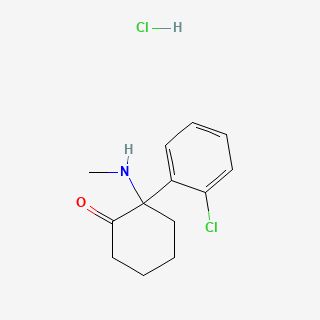
About this molecule
Ketamine is only found in individuals that have used or taken this drug. It is a cyclohexanone derivative used for induction of anesthesia. Its mechanism of action is not well understood, but ketamine can block NMDA receptors (receptors, N-methyl-D-aspartate) and may interact with sigma receptors. [PubChem] Ketamine has several clinically useful properties, including analgesia and less cardiorespiratory depressant effects than other anaesthetic agents, it also causes some stimulation of the cardiocascular system. Ketamine has been reported to produce general as well as local anaesthesia. It interacts with N-methyl-D-aspartate (NMDA) receptors, opioid receptors, monoaminergic receptors, muscarinic receptors and voltage sensitive Ca ion channels. Unlike other general anaesthetic agents, ketamine does not interact with GABA receptors.
Source: Toxin and Toxin Target Database (T3DB), via PubChem.
Identifiers
- IUPAC name
- 2-(2-chlorophenyl)-2-(methylamino)cyclohexan-1-one;hydrochloride
- InChIKey
- VCMGMSHEPQENPE-UHFFFAOYSA-N
- SMILES
- CNC1(CCCCC1=O)C2=CC=CC=C2Cl.Cl
- PubChem CID
- 15851
Also known as
KETAMINE HYDROCHLORIDE · Vetalar · KETAMINE HCL · Ketavet · CL 369 · Ketamine hydrochloride ciii · Ketamine (as hydrochloride) · (+-)-Ketamine hydrochloride
Chemical data on this page is drawn from PubChem (National Library of Medicine) and is provided for identification only. Hanpars does not hold stock of every substance listed; availability, grade, documentation and regulatory status are confirmed per enquiry.
Tell us the grade, the quantity and the market.
Send the molecule or ingredient, the specification and the destination. We reply from Tehran with the questions, the documents and the next step.